An Old-Fashioned Quilt
Adapted from The Foxfire Book
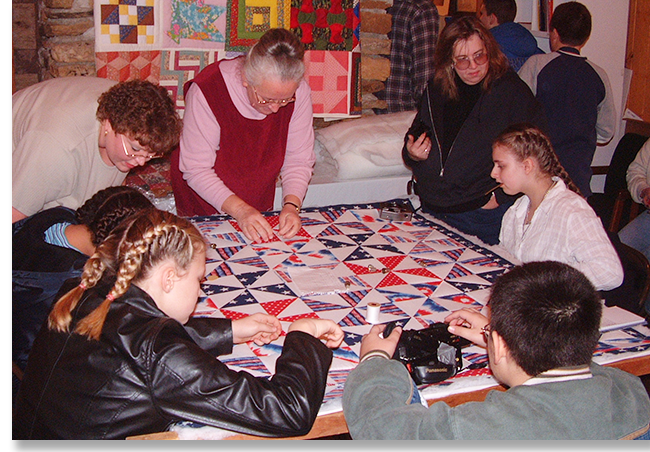
In the Fall of 1969, Foxfire student editors began to gather facts about quilting, as it was rapidly becoming of growing interest around the country. They attended quilting bees, copied patterns from quilts that had been hidden in trunks and attics for years and, at the last minute, turned up the most elaborate Friendship Quilt.
Originally, the plan was to find all those patterns that were native to this county. That proved to be impossible, for quilt patterns were like ballads—they moved constantly from community to community over surprisingly great distances. Media such as farmers' journals, newspaper columns, and even quilt pattern companies spread them farther. Even more complicating was the fact that patterns that were carried from the East with the first settlers in these mountains have been around so long that many of the owners consider them Rabun County patterns, which, of course, they are not. So, a sample pattern from quilts that have been made in Rabun County is included here. Drawn by former Foxfire student, Bill Roland, this star pattern has been known in this county for at least one hundred years.
Why the revival of interest in quilts in 1969 and again today? One explanation might be the statement back in 1969 by Mrs. Claude Darnell: "They's lots of people that wants to go back to th' old times." That, perhaps, but more explanations are true. The simple fact is that quilts were handmade by people for people. Giving and sharing permeated every phase of their production. From the trading of cotton scraps and patterns and the actual production in "bees" to the giving away of the final finished work, quilting was an essentially human activity. There is something about a quilt that says people, friendship, community, family, home, and love.
Aside from the quilting bees themselves, many customs and beliefs grew up around them. Patterns were traded like bubble gum cards. Especially beautiful ones became widely known. For example, Mrs. Grover Bradley told us, "Aunt Bede Norton had a basket pattern—just as pretty a basket as you ever saw; handle and all!" Grandmothers made at least one for each of their grandchildren to keep, and then pass on. A belief grew up that "If a young girl slept under a new cotton quilt, she would dream of th'boy she was goin' to marry." Especially fine ones were used to cover the bed on Sundays ("Sunday Quilts") and when company came.
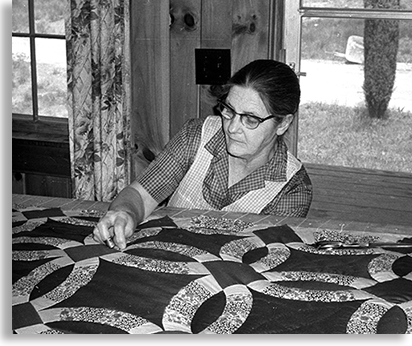 Basically, the quilt itself was, and is, a pretty simple project. It consists usually of a cotton bottom lining, a stuffing of cotton, a top cotton lining, and the pieced-top itself, but there the simplicity stops. The top was made of a number of separate cotton squares of cloth joined either side-to-side, or separated from each other by cloth borders. Each square was usually identical in pattern, but distinctive in color. The same person might make all the squares for one quilt, or they might be made by a number of different individuals who later got together to produce the final work. In addition, the patterns for the squares were as numerous as the quilts they embellished, as were the number of ways each pattern could be handled. There was even an array of styles in the actual stitching. Tiny stitches ("fancy quilts") made it fluff up more and were the most popular. Larger ones made the job go faster, and the stitches themselves could be employed to make independent designs.
At a quilting bee, the squares would have all been gathered up, and by the time the women had arrived, the host of the bee had sewn them all together into the completed top. The four-piece frame would be set up so that it rested on the backs of chairs (these days there are free-standing frames), the bottom cotton lining would have been attached, and the cotton "batting" and top lining would have been laid over that. Everything was ready for the actual quilting [stitching] to begin. Not only was a quilting bee for utilitarian purposes, it was also for social enjoyment of the women. Edith Darnell said, "It helps bring people together where they'd have quiltin'. It just seems like lot'a'pleasure. You're quiltin', you don't know you're quiltin'—a'talkin' and a'quiltin' too, and y'have lunch. I used t'enjoy goin' t'th'quiltin's."
Fancy or plain, however, the fact remains that cotton quilts seem to us symbolic of some of our finer human qualities. Perhaps this past and current revival of interest is a hopeful sign for all of us.
— Adapted from The Foxfire Book
For more information about Foxfire Museum and Heritage Center, their programs, publications and or events,
call (706) 746-5828, or visit their web site at www.Foxfire.org

The Blue Ridge Highlander logo, all photography, design, graphics, artwork, writing, digital images, etc are the Copyright © of C. Wayne Dukes and Sherry Bell Dukes, 1996 to current day, except where otherwise stated. All rights reserved, reproduction, downloading, and/or duplication of any sort is strictly prohibited, all violations will be prosecuted. Legal Policy. If you have any questions, or comments, regarding this site, e-mail the Highlander.